
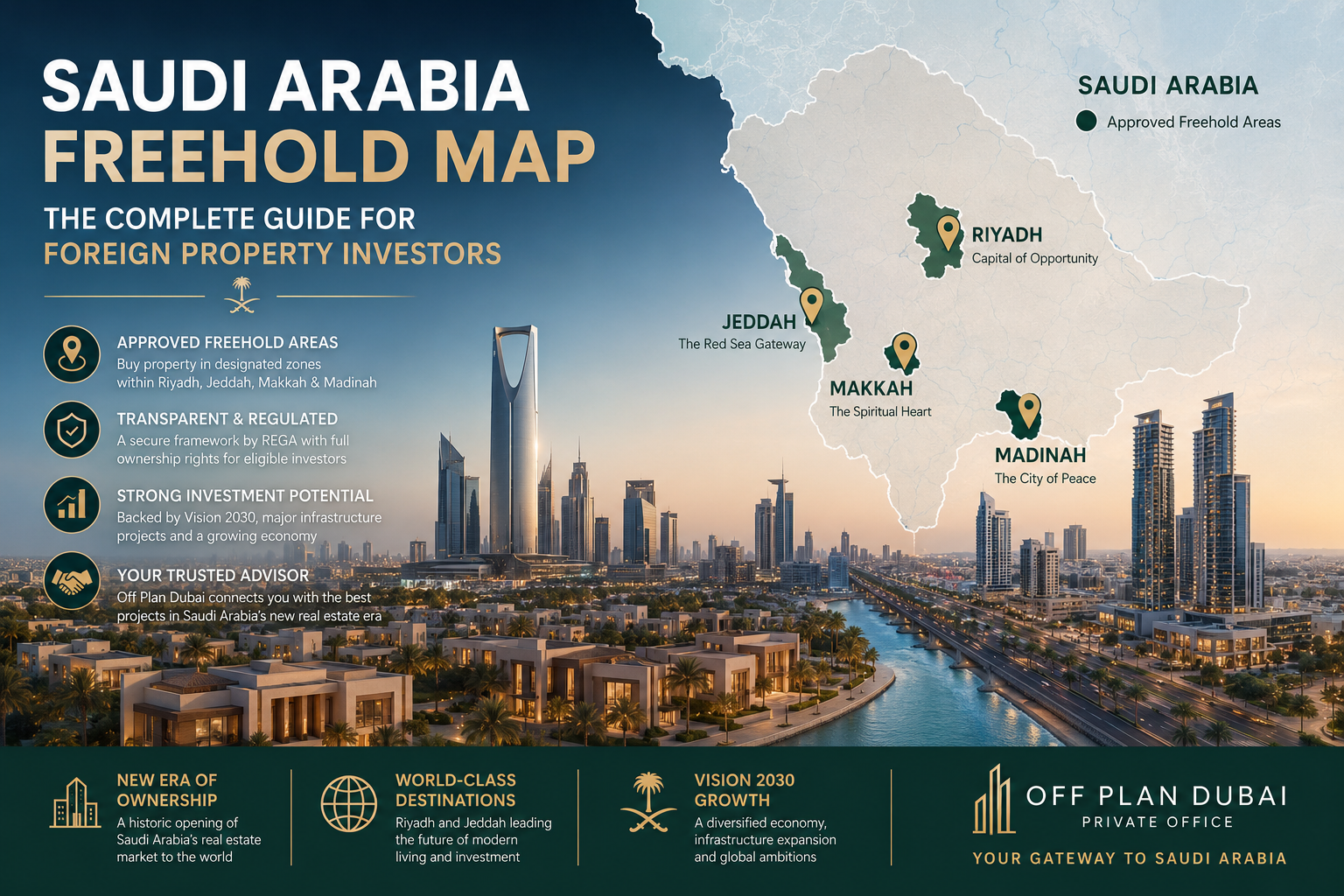
Saudi Arabia Freehold Map Explained: The Complete Guide for Foreign Property Investors
Saudi Arabia has entered a new chapter in its real estate history.
For decades, opportunities for foreign investors to purchase property in the Kingdom were limited and highly regulated. While international investment has long flowed into Saudi Arabia through businesses, infrastructure projects and institutional partnerships, direct ownership of residential real estate has remained relatively inaccessible for overseas buyers.
That is now changing.
The introduction of Saudi Arabia’s new Freehold Map represents one of the most significant milestones in the evolution of the Kingdom’s property market. Rather than opening every city and district to foreign ownership overnight, the Saudi government has introduced a structured framework that identifies approved geographic areas where non-Saudi nationals may purchase real estate, creating transparency for investors while supporting the long-term objectives of Vision 2030.
The interactive map clearly indicates where freehold ownership is permitted and is expected to expand over time as further developments and investment zones are approved. For investors, developers, and international buyers, this creates an entirely new level of visibility into one of the world’s fastest-growing real estate markets.
At Off Plan Dubai, we have spent years building relationships with many of Saudi Arabia’s leading developers and have already helped international investors place hundreds of millions of Saudi Riyals into carefully selected developments across Riyadh and Jeddah. The introduction of the Freehold Map is another major step in the Kingdom’s journey towards becoming one of the world’s most attractive destinations for global real estate investment.
In this guide, we explain exactly what the Saudi Arabia Freehold Map is, how it works, which cities are leading the market, and what it means for foreign investors looking to build wealth through Saudi real estate.
The Saudi Arabia Freehold Map is an official digital platform that identifies the geographical areas where foreign property ownership is permitted under the Kingdom’s evolving real estate regulations.
Rather than relying on individual approvals or isolated investment exemptions, the system introduces a transparent framework that enables investors to see where eligible developments are located and how ownership regulations apply in those areas.
As additional projects receive approval, they will continue to appear within the system, creating a dynamic map that reflects the ongoing expansion of Saudi Arabia’s freehold market.
This is particularly important because Saudi Arabia is not approaching foreign ownership in the same way as many other countries. Instead of opening the entire nation simultaneously, the government has adopted a carefully managed strategy that balances international investment with long-term urban planning.
For investors, this approach provides confidence.
For developers, it creates clarity.
For the Kingdom, it ensures that growth remains aligned with Vision 2030.
Many people see the Freehold Map simply as a new website.
In reality, it represents something much bigger.
Every mature international property market operates on three essential foundations.
Firstly, investors need legal certainty.
Secondly, ownership rights must be clearly defined.
Thirdly, buyers need confidence that the purchasing process is transparent and properly regulated.
The introduction of the Freehold Map demonstrates Saudi Arabia’s commitment to creating that environment precisely.
International investors can now begin to understand not only where they can invest, but also how the ownership process is structured.
For family offices, institutional investors and high-net-worth individuals, this is often just as important as the underlying property itself.
Large investors rarely allocate capital into markets where ownership rules remain uncertain.
By publishing approved investment zones and continuing to expand the system, Saudi Arabia is demonstrating that its property market is evolving into a globally investable asset class.
That represents an enormous shift.
The answer lies within Vision 2030.
Saudi Arabia is undertaking one of the largest economic transformation programmes ever attempted.
Rather than relying primarily on oil revenues, the Kingdom is investing across multiple sectors, including tourism, technology, financial services, entertainment, manufacturing, logistics, education and healthcare.
Real estate sits at the heart of this transformation.
New cities are being built.
Existing cities are expanding.
Transport infrastructure continues to develop.
International companies are relocating their regional headquarters.
Global brands are entering the Kingdom.
Luxury hospitality operators are investing billions.
Every one of these initiatives requires housing.
They require offices.
They require retail.
They require lifestyle communities.
Opening carefully selected areas to foreign investment allows Saudi Arabia to attract long-term international capital while accelerating development across strategic locations.
Rather than creating speculation, the objective is sustainable growth supported by genuine economic expansion.
That is one of the reasons many international investors now see Saudi Arabia differently from traditional emerging markets.
Over the past two years, our conversations with investors have changed dramatically.
Previously, many clients asked whether Saudi Arabia would eventually become accessible to overseas buyers.
Today, those conversations are focused on identifying the best opportunities before the market matures.
Institutional investors have increased their exposure.
Family offices are conducting detailed due diligence.
Private investors are recognising that Saudi Arabia is following a long-term economic strategy supported by substantial government investment.
Unlike markets driven primarily by speculation, Saudi Arabia’s growth is underpinned by population expansion, infrastructure development, economic diversification and national transformation.
That creates multiple drivers of demand simultaneously.
Residential demand continues to increase.
Corporate demand continues to expand.
Tourism continues to grow.
Employment continues to rise.
All of these factors contribute towards the long-term performance of real estate.
No city illustrates Saudi Arabia’s ambitions better than Riyadh.
Already one of the Middle East’s largest capitals, Riyadh is undergoing extraordinary change.
Government investment is reshaping the city through world-class infrastructure, new business districts, cultural attractions and large-scale residential communities designed to accommodate millions of additional residents over the coming decades.
Projects such as Diriyah, Sports Boulevard, King Salman Park, New Murabba and major transport improvements are fundamentally changing both the appearance and the functionality of the capital.
For investors, this creates a unique opportunity.
Rather than investing after a city has completed its transformation, buyers are entering while the transformation is still underway.
Historically, many of the world’s strongest performing property markets experienced their greatest capital appreciation during periods of significant infrastructure investment.
While past performance never guarantees future results, Riyadh shares several characteristics with cities that have experienced sustained long-term growth driven by government-led urban expansion.
One of Riyadh’s greatest strengths is the diversity of demand supporting the residential market.
Unlike resort destinations that rely primarily on tourism, Riyadh benefits from multiple independent demand drivers.
Government employees.
International businesses.
Technology companies.
Financial institutions.
Healthcare professionals.
Education providers.
Consultants.
Construction specialists.
Executives relocating from overseas.
Every new headquarters announced.
Every infrastructure project is completed.
Every multinational company entering the Kingdom creates additional housing demand.
This broad economic base helps create resilience across the property market.
For investors seeking long-term capital appreciation rather than short-term speculation, the diversity of demand is an important consideration.
Within Riyadh, few locations have attracted as much international attention as Diriyah.
Often described as one of the Kingdom’s most prestigious residential destinations, Diriyah combines historical significance with some of Saudi Arabia’s most ambitious luxury real estate.
The wider masterplan is designed to become a global destination, integrating culture, hospitality, retail, education, luxury living and tourism into one carefully planned community.
For international investors seeking exceptional residential opportunities, our detailed guides to Diriyah Property and Rayana Wadi Safar explain why these locations have become among the most sought-after addresses in Saudi Arabia.
Rayana offers a collection of branded luxury villas in the prestigious Wadi Safar district, while neighbouring communities such as Amara Wadi Safar and Altara Wadi Safar provide additional opportunities for buyers seeking prime freehold property in one of the Kingdom’s most exclusive residential environments.
What makes these communities particularly compelling is not simply their architecture or luxury amenities.
It is their position within a government-backed masterplan that is expected to remain one of the defining residential destinations of Vision 2030.
While Riyadh continues to dominate headlines as the Kingdom’s political and financial capital, Jeddah is quietly establishing itself as one of Saudi Arabia’s most compelling real estate investment destinations.
Known as the gateway to the Red Sea, Jeddah has long been one of the country’s most cosmopolitan cities. Its strategic location, established business community, international airport and waterfront lifestyle have made it an important commercial hub for decades. Today, significant government investment and private sector development are creating a new generation of residential communities designed specifically for modern living.
For overseas investors, Jeddah presents an attractive combination of lifestyle, infrastructure and relative value. Compared with many mature global cities, buyers can still access high-quality developments at prices that many believe offer long-term growth potential as international participation in the Saudi market continues to increase.
The introduction of the Freehold Map is particularly relevant to Jeddah because it provides greater transparency regarding the areas that will allow international ownership. As further projects are added to the official system, investors will have increasing visibility over where future opportunities are emerging.
One of the projects we believe best represents Jeddah’s future direction is Amaya Jeddah.
Positioned on King Abdulaziz Road, Amaya is far more than a residential development. It is a large-scale masterplan designed to create an integrated community combining apartments, luxury villas, commercial space, retail, hospitality and extensive public amenities.
The vision behind Amaya reflects a broader trend taking place across Saudi Arabia. Rather than developing isolated residential towers, developers are increasingly creating complete neighbourhoods where residents can live, work, exercise, shop and socialise within a single environment.
For investors, this integrated approach often creates stronger long-term demand because communities become destinations rather than simply collections of buildings.
As infrastructure surrounding these master plans continues to develop, well-positioned communities have the potential to benefit from improved connectivity and increasing demand from both owner-occupiers and tenants.
The launch of Padel Living Jeddah has demonstrated the current demand for well-priced freehold opportunities in the city.
Designed around contemporary urban living, Padel Living combines modern architecture with lifestyle-focused amenities, making it attractive to both investors and future residents. Early sales have reflected strong demand for projects within the evolving freehold framework that offer competitive entry prices.
One reason developments such as Padel Living have generated significant interest is that many investors recognise they are buying into a market that is still in the early stages of international participation. While no investment outcome can be guaranteed, entering a market during its formative years is often viewed differently from buying after years of established international demand.
For buyers seeking exposure to Saudi Arabia’s residential growth story, projects of this nature provide an accessible starting point while benefiting from the broader transformation taking place across Jeddah.
Demand for branded real estate continues to increase globally, and Saudi Arabia is no exception.
Projects such as Trump Plaza Jeddah demonstrate how internationally recognised brands are becoming part of the Kingdom’s premium residential offering.
Branded developments often appeal to investors because they combine high-quality design, professional management and global brand recognition. While every investment should be assessed on its own merits, branded residences have become an increasingly important segment of the international luxury property market.
As Saudi Arabia continues to attract international tourism, business travel, and executive relocations, branded residential developments are expected to become an increasingly important component of the country’s premium real estate sector.
One of the questions we are asked most frequently is:
“How difficult is it to buy property in Saudi Arabia as a foreign investor?”
The answer is becoming increasingly straightforward.
The introduction of the Freehold Map and associated digital systems is designed to simplify the ownership process by providing greater clarity around approved investment areas and the applicable regulations.
Although the exact process varies depending on the buyer’s residency status, nationality and the specific development, the journey generally includes:
As the framework continues to mature, digital integration is expected to make the purchasing process increasingly efficient for international investors.
Working with experienced advisers can also help buyers understand the differences between projects, payment plans, ownership structures and completion timelines.
If you are new to the market, our detailed How to Buy Property in Saudi Arabia guide (/how-to-buy-property-in-saudi-arabia) explains the purchasing journey in greater detail.
Every emerging property market experiences a period when awareness expands faster than supply.
While it is impossible to predict future prices, history has shown that markets undergoing significant economic transformation often attract increasing international attention as regulations become clearer and investment barriers are reduced.
Saudi Arabia today is attracting interest from institutional investors, sovereign wealth funds, private banks, family offices and high-net-worth individuals across Europe, Asia and North America.
As more international capital enters the market, competition for well-located developments is also likely to increase.
For that reason, many investors are focusing on projects launched in the early phases of the Kingdom’s freehold expansion rather than waiting until the market matures.
Every investor’s objectives are different, but understanding the market before it becomes widely adopted can provide a valuable perspective when evaluating long-term opportunities.
Yes. Foreign ownership is permitted within approved geographical areas and subject to the applicable regulations introduced under Saudi Arabia’s evolving freehold framework.
No. Ownership is limited to designated areas published through the official framework. Additional locations and developments are expected to be added over time.
Riyadh and Jeddah remain the primary focus for international residential investment due to the scale of development taking place and the range of new master-planned communities entering the market.
Yes, depending on the individual development and the applicable ownership regulations. Current opportunities range from entry-level apartments to branded luxury villas and ultra-prime mansions.
Many investors are attracted by Saudi Arabia’s long-term economic strategy, large-scale infrastructure investment and Vision 2030 programme. However, every investment should be assessed according to individual financial circumstances, objectives and risk tolerance.
Investing internationally is about far more than selecting a property.
It is about understanding the market, identifying the right opportunities and working with advisers who have direct access to leading developers.
At Off Plan Dubai, we have spent years building relationships across Saudi Arabia and have helped international investors deploy significant capital into carefully selected developments across Riyadh and Jeddah.
Our approach is based on identifying projects that combine strong locations, reputable developers, attractive payment structures and long-term growth potential.
Whether you are considering your first investment in Saudi Arabia or looking to expand an existing international portfolio, we provide guidance throughout the entire process, from selecting the right development through to completion.
To explore the wider market, visit our Saudi Property Investment hub, where you’ll find detailed guides covering freehold ownership, investment opportunities and the latest developments across the Kingdom.
Saudi Arabia’s Freehold Map is much more than a digital platform.
It represents a clear signal that the Kingdom continues to open its real estate market through a structured, transparent framework designed to attract long-term international investment.
Riyadh and Jeddah are already emerging as two of the most exciting property markets in the region, supported by unprecedented infrastructure spending, ambitious master-plans and one of the world’s most significant economic transformation programmes.
While every investment should be approached carefully and with appropriate professional advice, the combination of regulatory reform, economic diversification and increasing accessibility is creating opportunities that simply did not exist only a few years ago.
For investors seeking exposure to one of the world’s fastest-evolving real estate markets, understanding the Saudi Arabia Freehold Map is an important first step. As additional zones and developments are added to the official system, informed investors will be better placed to evaluate opportunities as the market continues to mature.
If you would like to discuss investing in Saudi Arabia, our team can provide access to carefully selected developments across Riyadh and Jeddah, explain the purchasing process, and help you identify opportunities aligned with your investment objectives.

Please enter your details to register your interest. Our investment expert will contact you to discuss the various opportunities, along with unit pricing and availability.


Off Plan Dubai
Suite: 508, Fairmont,
Sheikh Zayed Road,
P O Box 75671,
Dubai, UAE
Off Plan Dubai
167–169 Great Portland Street, 5th Floor, London, W1W 5PF.
The floor plans and brochure for this development will be emailed to you once you request further information from us.
 property@offplandubai.ae
  +44 7595 715 264